arXiv & code links coming soon
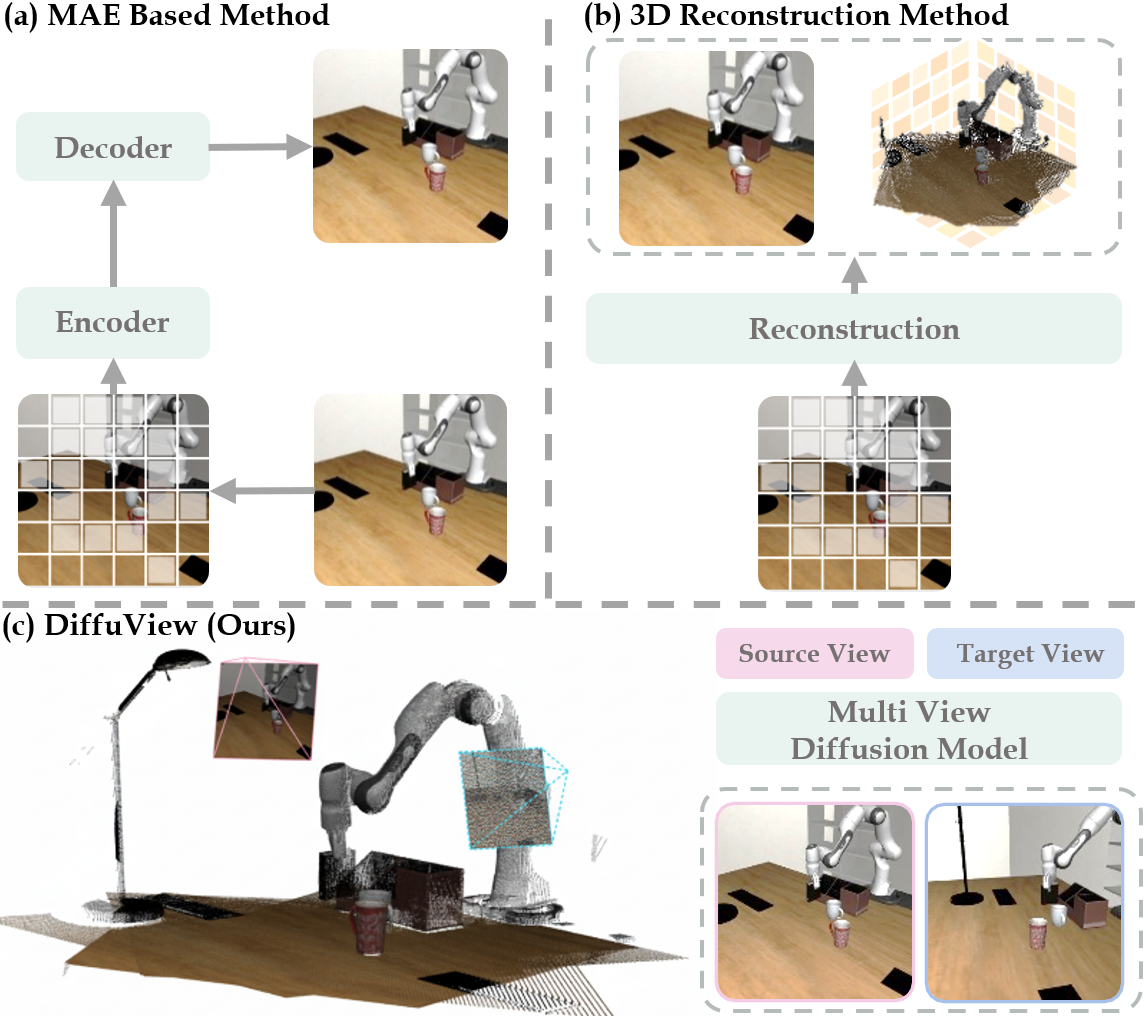
Robotic manipulation from visual observations remains challenging due to the lack of 3D-consistent representations that generalize across diverse viewpoints and sensor configurations. Existing methods, primarily based on masked autoencoders or neural scene representations, struggle to capture robust view correspondences due to a lack of global 3D consistency or the requirement for scene-specific optimization. While multi-view diffusion models have recently shown tremendous success in 3D-aware generative synthesis, their powerful representations offer a promising direction for viewpoint-robust visuomotor control.
We introduce DiffuView, a novel framework that learns unified 3D-aware representations through multi-view diffusion pretraining and deploys them for imitation learning. DiffuView models the conditional generation of target views given source observations within a diffusion framework, enabling the network to implicitly recover scene geometry and enforce view consistency. The pretrained diffusion network is then used as a powerful visual backbone for an action policy, allowing robust control under varying viewpoints and visual conditions. On the MetaWorld and LIBERO benchmarks — in both simulation and the real world — DiffuView achieves superior generalization, improving success rates under viewpoint shifts by nearly 20% over existing methods.
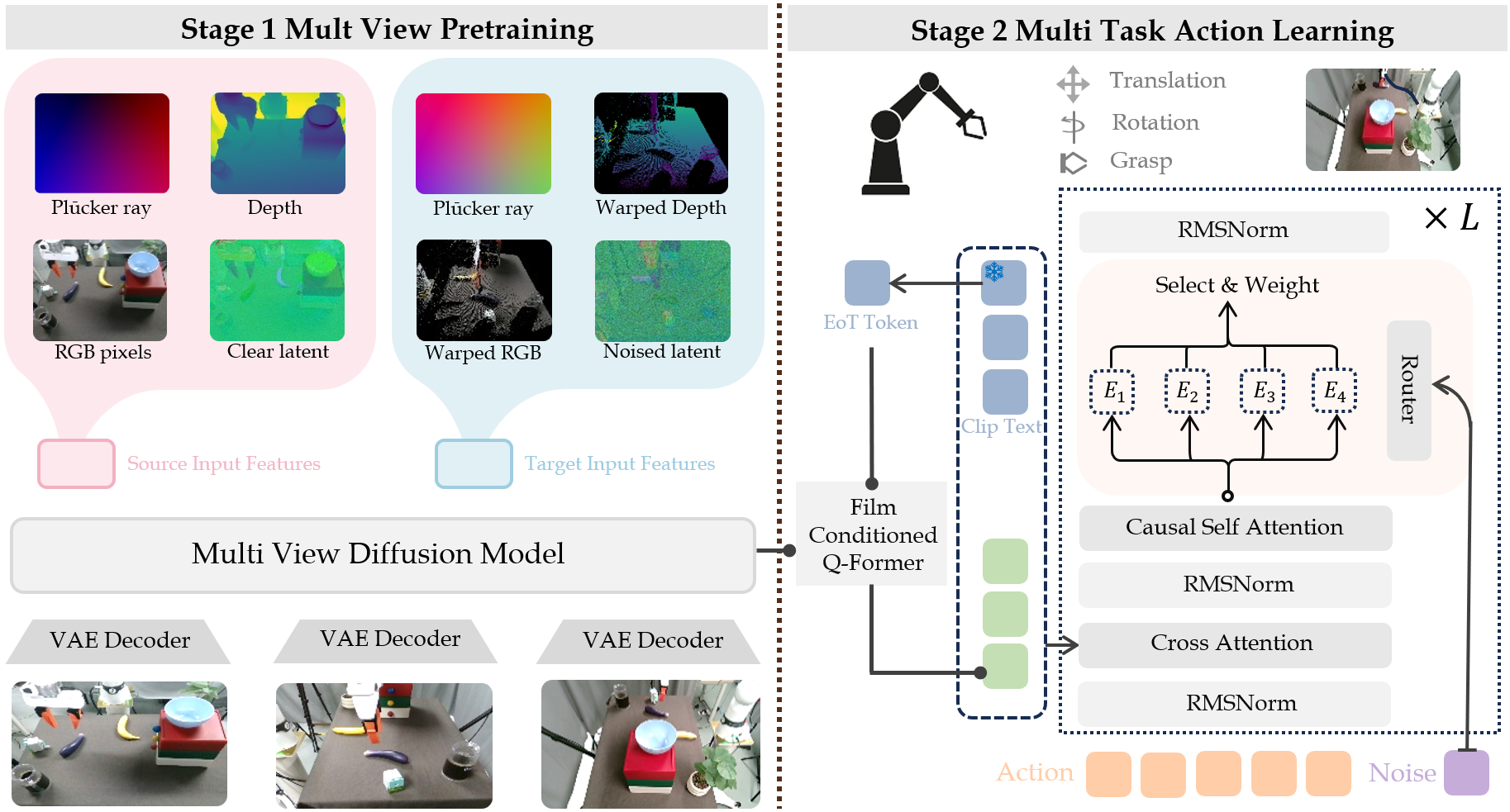
(Left) Stage 1 — Multi-View Diffusion Pretraining. Target views are reconstructed from source observations using Plücker rays, depth, and warped RGB-depth pairs to learn 3D-consistent latent features. (Right) Stage 2 — Policy Learning. The pretrained backbone acts as a 3D-aware encoder; a FiLM-conditioned Query Transformer (Q-Former) with CLIP text guidance produces task-aware tokens that condition a Mixture-of-Denoising-Experts (MoDE) diffusion policy. A noise token η(σt) modulates attention and drives a noise-conditioned router that sparsely activates experts for faster inference.
Given a source observation captured at a known pose and intrinsics, we compute 3D points and reproject them into the target camera to obtain warped RGB and depth maps. For RGB-D cameras the measured depth is used directly; for RGB-only setups a metric depth estimator supplies the geometric conditioning. We further inject per-pixel camera geometry via dense Plücker ray embeddings. These geometric cues are fused into the VAE latents through a lightweight convolutional encoder, after which the diffusion model applies 2D spatial attention within each view and 3D full attention across views to reason about cross-view geometry.
After pretraining, the diffusion UNet is repurposed as a 3D-aware vision encoder — serving both as a feature extractor and as a viewpoint-adaptive encoder. Following VPP, we perform only a single diffusion forward pass and extract multi-scale features from the UNet upsampling layers. A FiLM-conditioned Q-Former, modulated by the CLIP end-of-text token, produces compact task-relevant visual embeddings that condition a diffusion policy. The policy integrates observation and language embeddings via cross-attention, replaces LayerNorm with RMSNorm, adds action causal self-attention for temporal consistency, and uses a noise-timestep conditioned Mixture-of-Experts (Top-2 of 4 experts) to accelerate denoising.
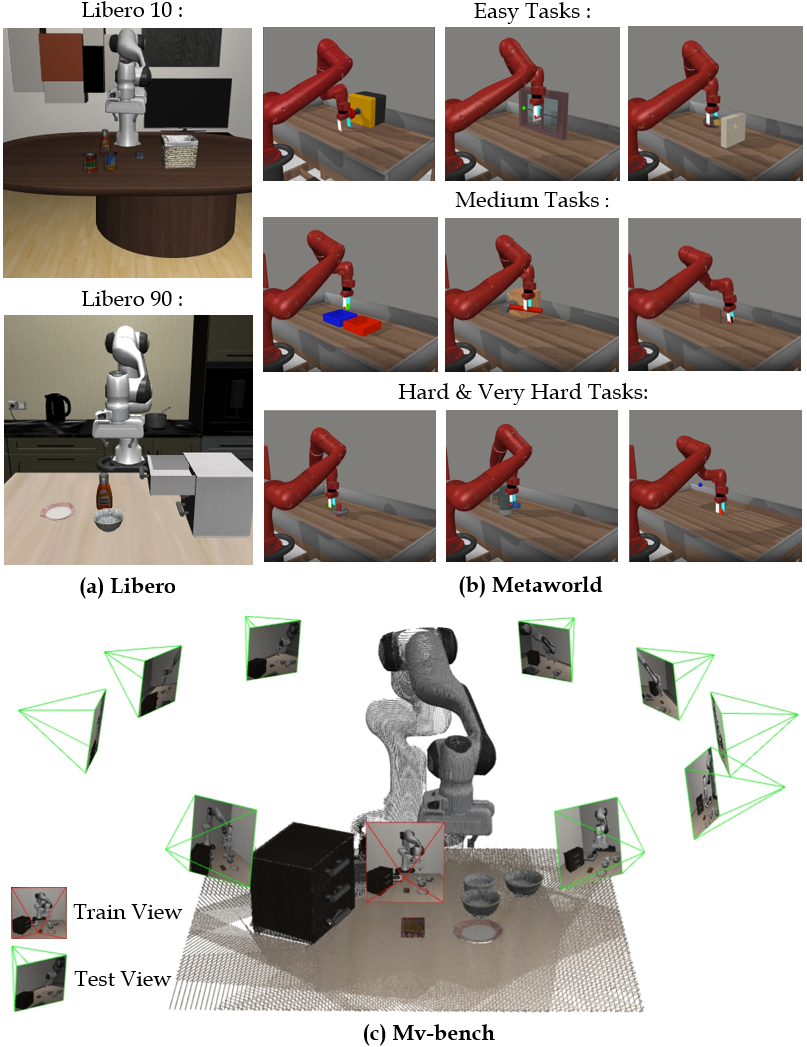
Simulation benchmarks. We evaluate on (a) LIBERO and (b) MetaWorld, covering a diverse array of manipulation tasks with varying difficulty. (c) We also build Mv-Bench, a self-formulated benchmark specifically designed to evaluate view-adaptive capability.
| Benchmark | DP | MT-ACT | MDT | OpenVLA | Dita | VQVLA | π0.5-ki | DiffuView (Ours) |
|---|---|---|---|---|---|---|---|---|
| LIBERO-10 | 51.0 | 68.0 | 65.0 | 53.7 | 63.8 | – | 84.8 | 89.2 |
| LIBERO-90 | 69.0 | 54.0 | 66.9 | 74.8 | – | 81.0 | 92.7 | 92.5 |
| Average (100 tasks) | 67.2 | 55.4 | 66.7 | 72.7 | – | – | 91.9 | 92.2 |
Success rate (%) on the LIBERO benchmark. Best in blue.
| Task Level (Numbers) | RT-1 | DP | SuSIE | GR-1 | Baku | VPP | DiffuView (Ours) |
|---|---|---|---|---|---|---|---|
| Easy (28 tasks) | 0.605 | 0.442 | 0.560 | 0.725 | 0.831 | 0.818 | 0.836 |
| Medium (11 tasks) | 0.042 | 0.062 | 0.196 | 0.327 | 0.527 | 0.493 | 0.542 |
| Hard & Very Hard (11 tasks) | 0.015 | 0.095 | 0.255 | 0.451 | 0.346 | 0.526 | 0.537 |
| Average (50 tasks) | 0.351 | 0.282 | 0.413 | 0.577 | 0.530 | 0.682 | 0.706 |
Success rate on the MetaWorld benchmark. Best in blue.
The policy takes only a single view as input during both training and inference. We train on one fixed view (LIBERO agent view) and test across unseen viewpoints generated by rotating the camera around the robot base along the z-axis. DiffuView maintains stable performance under large viewpoint shifts, whereas the baseline collapses once the camera deviates from the training angle.
| Method | −30° | −15° | 0° | 15° | 30° | 45° | 60° | Average |
|---|---|---|---|---|---|---|---|---|
| OpenVLA | 25.7 | 62.4 | 84.7 | 54.8 | 26.4 | 12.6 | 8.2 | 39.3 |
| DiffuView (Ours) | 52.4 | 67.9 | 86.2 | 72.9 | 55.3 | 44.9 | 34.6 | 59.2 |
Mv-Bench success rate (%) across rotated viewpoints. DiffuView improves the average by ~20 points.
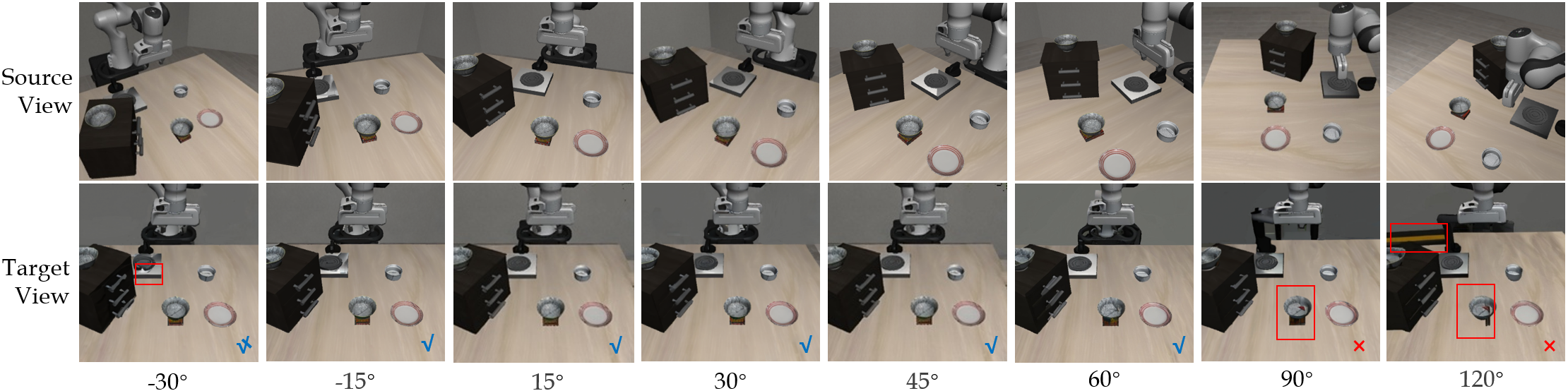
Our pretrained model serves as a view-adaptive module, competently handling view transformation within −30° ∼ 60°.
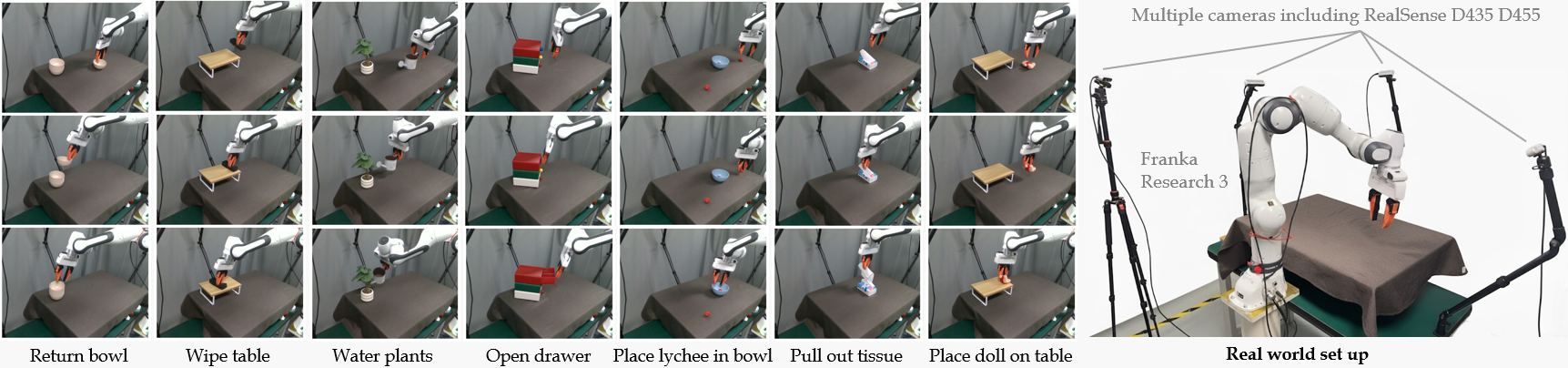
Successful rollouts of DiffuView (left) and the real-world setup (right). Experiments use a Franka Research 3 arm with RealSense D435/D455 cameras providing multiple viewpoints and sensor configurations.
| Method | Wipe table | Return bowl | Open drawer | Pull out tissue | Average |
|---|---|---|---|---|---|
| DP | 0.28 | 0.49 | 0.75 | 0.51 | 0.51 |
| OpenVLA | 0.49 | 0.62 | 0.74 | 0.68 | 0.63 |
| DiffuView (Ours) | 0.68 | 0.60 | 0.77 | 0.54 | 0.65 |
Real-world success rate on 4 challenging manipulation tasks.
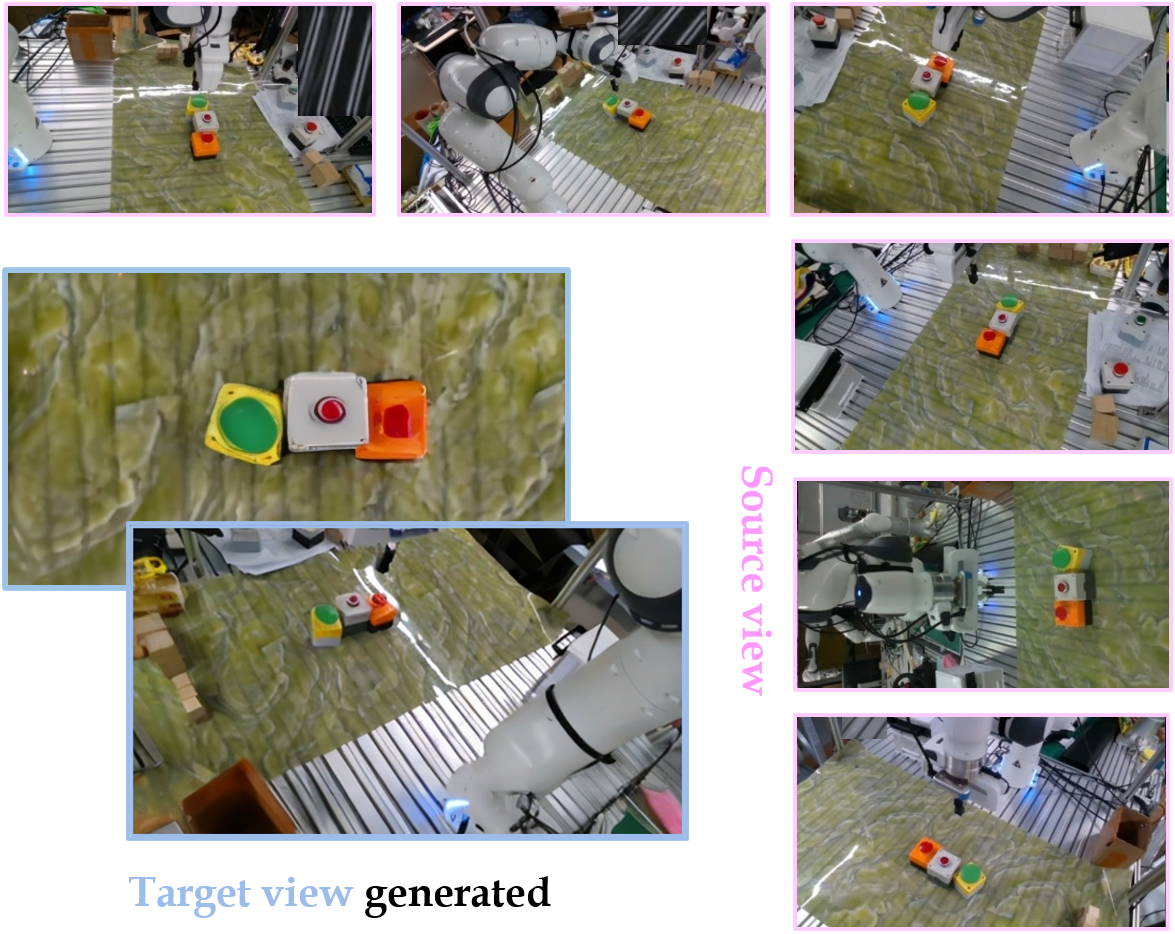
Wrist-view and third-view generation on real-world data. Pink boxes are source images from various viewpoints; the blue box is the target view to restore.
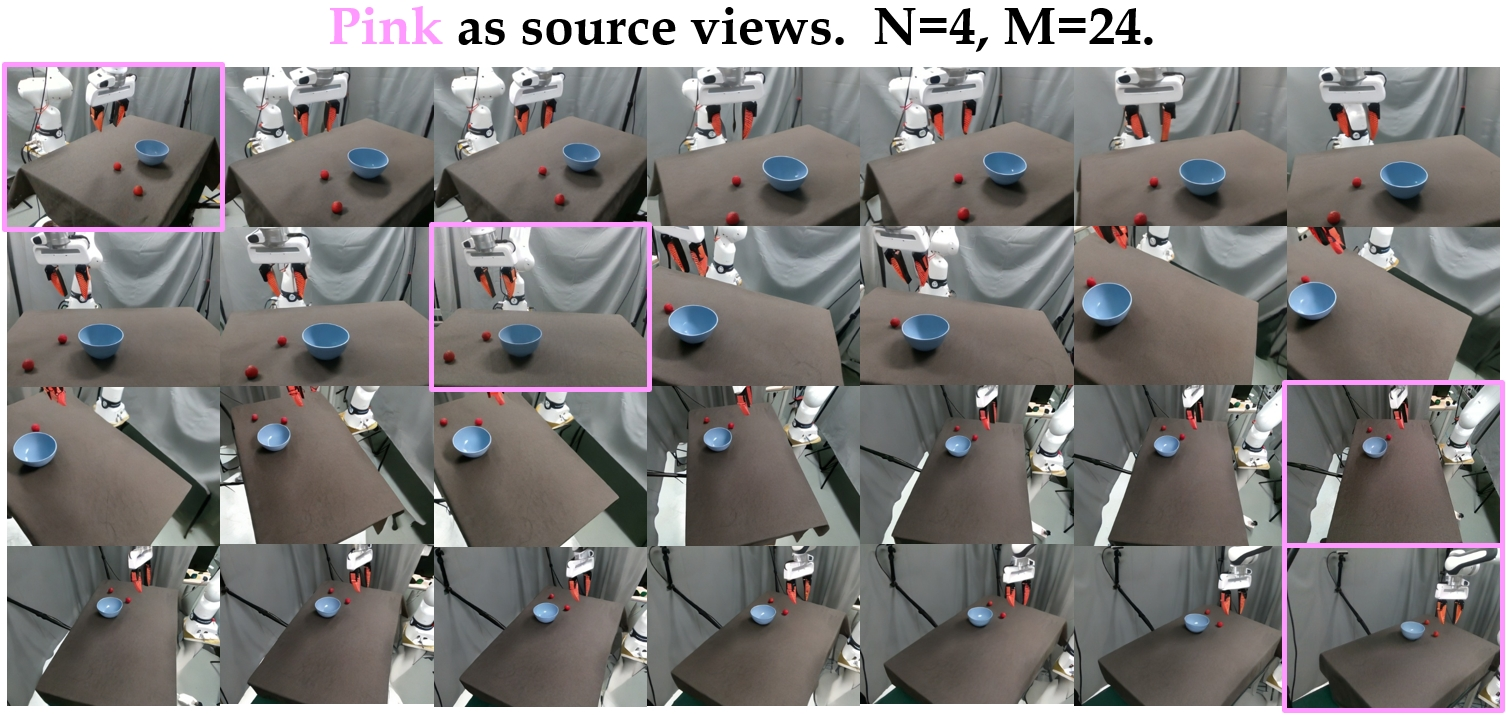
Qualitative results of real-world multi-view diffusion, showcasing the adaptive scheme for varying numbers of inference views.
| Ablation | Success Rate |
|---|---|
| DiffuView (full) | 89.2 |
| w/o Robotics Data Pretraining | 63.3 |
| w/o Plücker Embedding | 76.2 |
| w/o FiLM Conditioning in Q-Former | 73.3 |
| Noise-Conditioned Experts Top K=1 | 87.7 |
Each component contributes: robot-centric pretraining (−25.9), Plücker geometry (−13.0), and FiLM language conditioning (−15.9) are the most impactful.
We proposed DiffuView, a two-stage framework that learns 3D-consistent visuomotor representations through multi-view diffusion pretraining and multi-task diffusion-based policy learning. DiffuView achieves state-of-the-art performance across multiple simulated manipulation benchmarks, and on the proposed Mv-Bench it robustly handles large viewpoint shifts — establishing a new paradigm for representation learning in robotic manipulation.
Limitation & future work. The current pretraining lacks explicit understanding of dynamic temporal information, limiting reasoning about motion continuity. We plan to extend DiffuView toward a joint flexible-view and time pretraining framework for unified spatial-temporal representation learning.
@inproceedings{zhang2026diffuview,
  title     = {DiffuView: Multi-View Diffusion Pretraining for 3D-Aware Robotic Manipulation},
  author    = {Zhang, Kaizhao and Niu, Tian and Liu, Tianyu and Guo, Chenen and
               Xu, Zijun and Hu, Qingda and Ding, Wenchao},
  booktitle = {Proceedings of the IEEE/CVF Conference on Computer Vision and Pattern Recognition (CVPR)},
  year      = {2026}
}